The UK’s “Daybreak” (iTV) is kind of “The Today Show” with posh accents … this segment was featured during their recent “Parent Week.” Check out the editing – presenter Nick Dixon confessed to being mega-proud of it. And the crime-scene tape is a killer!
The Lost Art of Staring Into Space
Elizabeth Benedict
“Which do you prefer — sex or a pastrami sandwich?” one guy asks another, though it’s not a proposition but a light-hearted survey. “To tell you the truth,” the other guy says, “sometimes the sandwich.” This exchange is lodged in my memory, overheard a dozen years ago at a restaurant.
It reminds me of a scene from last Sunday at the Buttercup Bake Shop near my apartment, a heartbreaking power struggle involving competing temptations: technology, love and sugar. I watched a girl, about 10 years old, eat a cupcake and try to get her mother’s attention, but Mom had eyes and fingers only for her iPhone. There was no evidence she’d even eaten a cupcake. She scrolled through emails for the entire time I sat next to them, 20 minutes. iPhone 1 – Cupcake 0. iPhone 1 – Daughter 0.
The Onion weighs in … in typical style. Love the shout-out to Hollywood that kicks it all off. Nancy Meyers, are you listening?
The Onion Review :: The Winter of Our Disconnect
Tasha Robinson
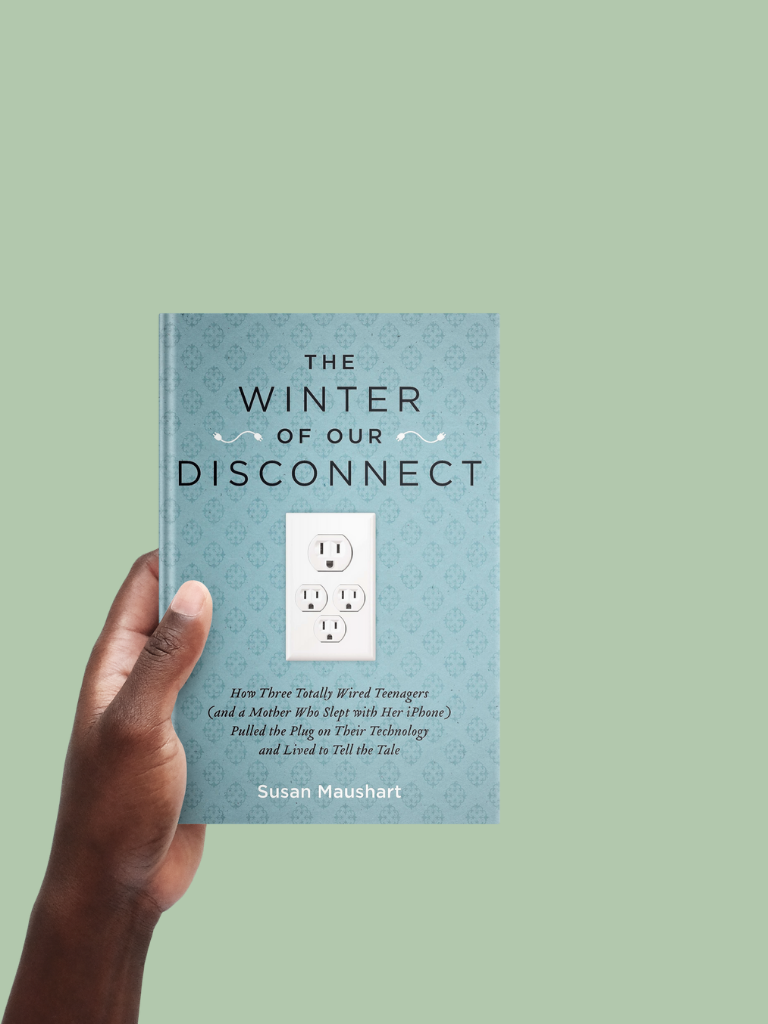
If Susan Maushart’s book The Winter Of Our Disconnect: How Three Totally Wired Teenagers (And A Mother Who Slept With Her iPhone) Pulled The Plug On Their Technology And Lived To Tell The Tale hasn’t been made into a movie within a year or two, it’s proof that everyone in Hollywood is asleep at the switch. It’s the perfect cinema-ready blend of zeitgeist-tapping story and heartwarming uplift piece. It’s infinitely relatable for anyone who owns more than three portable electronic devices. It’s full of wry-but-Middle-America-friendly comic moments, and it comes with a built-in moral. Given all that, it’s also pat and predictable, a by-the-numbers mash-up of the lifestyle-experiment book genre (see also The Year Of Living Biblically, Julie & Julia, Living Oprah, etc.) and an Erma Bombeck family-humor book. But like so many lifestyle-experiment books, it asks readers to look up from their routines and actually notice their own lives for a moment, and it’s hard to see that as a bad thing.
As the subtitle spells out, Winter Of Our Disconnect documents a six-month period where Perth author/journalist Maushart and her three reluctant, bribed-into-compliance teenagers gave up anything with a screen: cell phones, computers, TVs, gaming systems, mp3 players, and so forth. (Use of school computers or friends’ TVs or games were permitted; technology was just banned from the home and the participants’ personal possession.) The broad results won’t surprise any reader: Maushart and her family members were initially bored and at a loss, but soon started entertaining themselves by coming closer as a family and engaging in time-consuming tasks they’d been too addled and distracted for, like cooking, learning a musical instrument, reading books, and simply having long, intimate conversations with each other.
One of my favorite gigs EVER was acting as executive producer/presenter for ABC Radio’s StoryCatcher project – a life-story series inspired by NPR’s amazing StoryCorps initiative. (For the full Storycatcher story, head to http://www.abc.net.au/perth/storycatcher/ )
Some of the best stories we caught were put together into a 10-part summer series – Australian summer, that is - broadcast nationally in Dec 2010/Jan 2011. Here’s the complete series, along with download links.
Audio clip: Adobe Flash Player (version 9 or above) is required to play this audio clip. Download the latest version here. You also need to have JavaScript enabled in your browser.
Without being wired, family connected again
Chuck Leddy
Susan Maushart, a divorced mother of three teenagers, noticed how digital technology, from Facebook to online gaming to constant text messaging, had fractured her family into independent fiefdoms. Connected only to their devices and their online “friends,’’ the Maushart family had stopped eating together and rarely held real-world conversations. As Maushart puts it, “I started considering . . . the possibility that the more we connect, the further we may drift, the more fragmented we may become.’’
After rereading “Walden,’’ about Henry David Thoreau’s famous two-year stint living in solitude alongside a Concord pond, Maushart, a journalist and social scientist with a doctorate from New York University in communication arts and science, was inspired to begin her own experiment in mindful living: For a six-month period, she would allow her family no in-home access to any screen, including computers, cellphones, and televisions. Needless to say, her teenagers were less than thrilled, but, as Maushart’s provocative, funny, and highly personal memoir shows, it changed them all profoundly.
For the second time Yahoo! News – courtesy of the Associated Press – has featured a piece showcasing my book. Okay, mentioning it. Details, details. This one may bring out a few WTFs, or even an LOL while reading. Sussy is quoted extensively (which made her lol) but she is not that happy with the definition of her beloved expression “k dot”. She urges readers to head to urban dictionary for a deeper understanding … Anyhow is an excerpt, plus a link for the full article.
OMG, when did we start talking like txt msgs?
Jocelyn Noveck
“ILY!” Susan Maushart’s 16-year-old daughter often calls out over her shoulder as she leaves the house. Sure, actual words would be better. But Mom knows not to complain.
“A mother of teenagers is pathetically grateful for an `I love you’ no matter what form it takes,” she observes.
Then there are the various forms of “LOL” that her teens use in regular parlance — it’s become a conjugable verb by now. And of course, there’s the saltier acronym used by son Bill: “WTF, Mom?!” But before you judge, note that former VP candidate Sarah Palin just used that one in a TV interview. And CNN’s Anderson Cooper used it on his show the other night.
Karen Lillington wrote a phenomenal article for the Irish Times titled “Information Flatulence“. Great title, too - am pretty sure it’s taken from the book, now that I immodestly think about it …
It’s fascinating to see how various countries are viewing “the experiment.” I’ve had mail from China, Poland, Spain, Chile, Korea, Turkey, Hungary … and Brazil, where the publishing rights have just been sold. There’s no doubt about it. Sometimes technology really can be our friend.
Information Flatulence
Karen Lillington
WHEN TWO small girls, aged 10 and 12, were trapped in a storm drain in Australia in 2009 they might easily have perished. Fortunately, they had their mobile phones with them and immediately sought help – by updating their status on their Facebook pages. Lucky for them, a schoolfriend quickly saw the update, the authorities were notified and they all lived happily ever after.
The story, one of many amusingly telling yet quietly alarming anecdotes in Susan Maushart’s The Winter of Our Disconnect , perfectly illustrates her starting premise that Digital Natives – those children and young adults who have never known anything but a life with their faces turned towards screens and the internet – think and act differently from those of us who can remember a world before “friend” became a verb.
Cringe! TV is sooo not my medium. But when Sussy and I (along with a special guest via Skype … ANNI!!!!!!) were summoned to 30 Rock – aka 30 Rockefeller Plaza, aka NBC – to be interviewed by Meredith Vierira on the Today Show to discuss “the experiment” that was our 6-month tech detox we sure as hell weren’t gonna say we were busy!
Personal highlight: Spying Martha Stewart chewing out her make-up girl in the dressing room behind us.
Somewhat less thrillingly, below is the full interview, along with a download.
My best Christmas present this year – though I did love those socks, honey – was having Oprah (through her website and magazine, but still) announce The Winter of Our Disconnect as one of the top 15 books to look out for in January.
Below is a screen shot of the feature, along with a click through to the write-up on Oprah’s web page.